Showing posts with label body image. Show all posts

Tuesday, May 5, 2015

Coming Soon! Gertie's New Fashion Sketchbook: Indispensable Figure Templates for Body-Positive Design


Readers! Between book projects, I've been working on a  . . . wait for it . . . book project! But this is a sketchbook project and one with a super exciting concept at that. Let me explain.

Have you ever bought one of those fashion sketchpads filled with croquis (body figure templates) all excited to hash out your ideas? And then once you realize the figures are a little bizarre-looking, your excitement fades a bit? (By "bizarre," I mean that the figures are strangely elongated and spindly, and twisted into strange poses like the "broken doll" or the "sad alien.") That's because fashion people work with a concept called "nine heads," where the figure is nine head-lengths tall. To put this in perspective, actual people are only seven to eight heads tall. Here's an interesting image that breaks it down:

Source

One of my missions over years has been to write about sewing and fashion in a body-positive, feminist way. So these nine-head ladies were bringing me down. And so the idea for this sketchbook was born and brilliant illustrator Sun Young Park brought it to life. Here's how it works:

For Gertie’s New Fashion Sketchbook, Gretchen Hirsch teamed up with illustrator Sun Young Park to reinvent traditional figure templates—known as croquis—for the 21st century. Instead of the unnaturally skinny, tall, and frequently off-balance croquis the fashion industry has been sketching on for decades, this game-changing alternative presents hundreds of realistically sized and proportioned female forms in balanced, lifelike poses. In addition, Park has rendered the croquis with multiple tracing lines, allowing the sketcher to follow the lines that most accurately reflect the body shape desired. Also included are an overview of the design and sketching process and a visual history of garment component styles, all to make it easier to create fashion sketches for women of all shapes and sizes.

The figures are presented in a "nested" configuration (almost like a sewing pattern!), so that you can follow the lines (bigger or smaller) to represent different figures. You can make the figures smaller on top or bottom to replicate a woman's actual curves and proportions. I tested the whole thing out with some wonderful sewing friends, and it really works! I can't wait to show you more once the actual books arrive.

But for now, just know that the sketchbook is available for pre-order!

Tuesday, January 28, 2014

Body Snark, Vintage Hollywood Style

There's a fascinating article in the most recent issue of Entertainment Weekly about Irene Sharaff, a costume designer who had a hugely successful Broadway and Hollywood career. She earned a whopping 16 Oscar nominations. The article is a retrospective look at some of her biggest productions. However, I could not get past this quote on the first page, about a Hollywood actress she designed for:

"She was five feet two and had difficult proportions: high waist, large bosom, short arms, no behind, and wide hips. I was not awed by her." 

Readers, Sharaff was talking about Elizabeth Taylor. Can you imagine?!


My first thought: If Taylor had "difficult proportions," the rest of us are screwed. It's sad to read a quote like that--I mistakenly assume that Hollywood had more realistic expectations of stars in the 50s and 60s, when a more womanly figure was in fashion.

On the other hand, it's kind of nice to read a designer's candor about the challenges of obtaining Hollywood perfection, even for an hourglass figure like Taylor. Obviously, even female costumers are not immune from the pressures of creating a perfect screen-ready body at any cost.


Sharaff won the Oscar for her designs for Cleopatra in 1963. Despite Sharaff being underwhelmed by Taylor, they must have been on good terms. Sharaff designed the dress Liz wore for her first wedding to Richard Burton.


Sharaff seems to have been known for her bitchy quips. Of working with Faye Dunaway on Mommie Dearest, Sharaff said: "Yes, you may enter Miss Dunaway's dressing room, but first you must throw a raw steak in--to divert her attention."

Sharaff, like Edith Head, had an idiosyncratic sense of style. She wore super heavy eyeliner, a dramatic up-do, and lots of black.

Fun fact: Sharaff and her team designed 26,000 costumes for Cleopatra. Does that even seem possible?!

Friday, November 1, 2013

Before and After: Thoughts on Makeup and Self-Image

The checkout line at my local grocery store always has a large selection of tabloids. Lately, a popular headline has been "Stars Without Makeup! You Won't Believe How Disgusting They Look!" or something like that. During the photoshoot for book #2 this week, I kept thinking about those tabloids.

I modeled on day two of the shoot, and thought it would be fun to capture the transition from mere mortal to model. I came into the studio with unstyled hair and no makeup (left picture) and an hour later I was all spackled and curled and ready to go!

On the subway to the shoot, I felt embarrassed by my lack of styling. On the way home that night, I felt embarrassed by all the makeup migrating to my under-eye region. You just can't win, right?

My everyday look is somewhere between these two extremes, which I guess is the case for most women. And I think we all have somewhat conflicting emotions about the whole thing. There's certainly no lack of pressure to conform to an ideal of beauty in our world. Think about all the time, money, and effort spent on products to achieve that ideal. It's exhausting! Do we like to read those tabloids about "stars without makeup" to make ourselves feel better? I think once you know how much work goes into a fully made-up look, you can let yourself off the hook a bit.

On the other hand, who doesn't like to play dress up? It's nice to have the option to go all out.

What do you think--do you feel bad about yourself sans makeup? Or do you regularly go au natural?

Tuesday, June 11, 2013

That Fleshy Armpit Bit


A while back, I posted a magazine cover that showed a model from a side angle in a cap sleeve dress. Several people commented that the view of the model's fleshy underarm bit was unsightly. Now, while the angle of the photo wasn't my favorite for showing off a dress, it never would have occurred to me to be bothered by the model's underarm, of all things. I've spent long enough obsessing about various parts of my body, and it never even occurred to me that I was missing a vital part of myself to be disgusted by! So, to catch you all up: this is the part of the body where the arm meets the torso, and there's a little fold of flesh. Mon dieu!

Ever since then, I notice my fleshy underarm bits ALL THE TIME. There they are, just hanging out, being all unsightly.


I can't even get them to go away by distorting myself--no fair!

In all truthiness, I actually quite like those little flaps. I don't actually find them unsightly, unbecoming, or disgusting. I mean, what's the alternative? Maybe some sort of Barbie mutant arm that connects to the torso by plastic peg . . .

What does bother me, is that I'm now aware of the fleshy armpit bits. I scrutinize photos of myself, wondering if I'll be criticized like the model on the cover of that magazine. And I seriously resent having one more part of my body to worry about--like it wasn't enough to obsess over my tummy, triceps, biceps, hips, thigh circumference, inner thigh area, neck waddle, ankles, boobs, back fat, saddlebags, behind-knee area, hairy toes, upper lip, . . . . ok, you get the point.

So, here's my suggestion: can we all just agree, as women, that the fleshy armpit bit is of no concern? That it's normal, not repulsive? That it doesn't need to be covered in shame? Because, seriously, my brain is going to explode if I spend one more second worrying about it.

Or, alternatively, we could decide that it's just the sexiest part of the body ever and flaunt our armpit flaps brazenly all summer. What do you think?


Thursday, December 20, 2012

Going Rogue

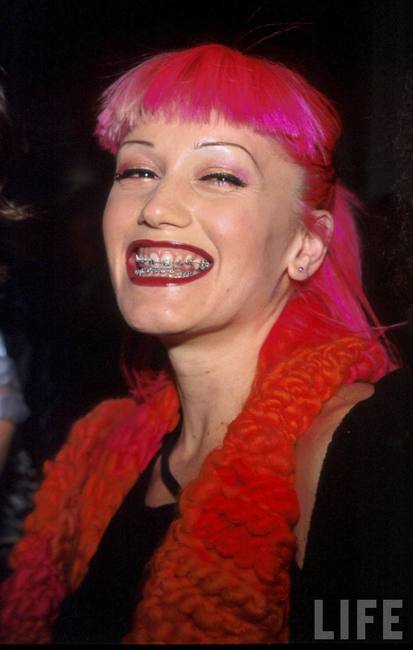
Gwen Stefani, late 90s
In my last post, I wrote about the maintenance and care of pink hair, but I realized I really want to talk more about the cultural implications of "alternative" beauty. (Another week, another crackpot feminist theory!)

I've been thinking lately about all the upkeep that is sold to us to be considered conventionally beautiful as a woman. Bikini waxes, gloss treatments, manicures, anti-aging treatments, etc. It's kind of exhausting just thinking about it, right? It's gotten me thinking that maybe the appeal of having an "unnatural" hair color is that you mentally put yourself outside of the rules of regular beauty. Maybe the message pink hair (or tattoos or piercings) sends is that you're not playing by the rules--so you can take your laser hair removal and shove it, okay? It's a liberating mindset.

You know those women's magazine articles that tell you the "top beauty don'ts" and stuff like that? As a younger woman, I remember reading on several occasions that it's an absolute crime to have a chipped manicure. I took it as gospel for a while, I suppose. But the day I realized that chipped nails aren't the end of the world, and can even look kind of cool (if you're into the whole grunge thing), it was kind of like a weight had been lifted.

The problem with this whole theory is that it's prone to backfire really, really quickly. Once you're considered an "alternative girl," you're sexualized in a whole new way. If you've ever had a dude on the street ask if you're a Suicide Girl, you know what I'm talking about. So while going rogue, beauty-wise, can be freeing--it definitely comes with its own set of issues. And it certainly doesn't make you oblivious or immune to regular beauty standards.

And even if you don't have pink hair or piercings, I think anyone reading this can relate in a way. Sewing your own clothes is the ultimate form of going rogue on the fashion and diet industries, I think. Making clothes to fit yourself (rather than making yourself fit clothes), is another way of going rogue. We can also stop being slaves to the trend-driven retail market and wear what we love--there are really no limits when you make it yourself.

Do you agree with all this? Do you see your sewing (or hair or whatever) as a form of rebellion against the status quo? Or is it naive to think that's even possible?

Tuesday, November 27, 2012

Taking a Hair Risk


Well, I did it! All pink, readers. I love it. But I have to say, I really struggled with this decision. I think that's because hair color is tied to so many other issues: self image, aging, public perception, standards of beauty, etc. I've realized from comments here and elsewhere that if you're someone who is thought of as conventionally attractive, people consider it a crime to do any sort of body modification. "But your natural hair color was so pretty!" If I had your skin, I'd never get a tattoo!" Stuff of that nature. That brings up so many questions about beauty: pink hair dye is only for people who have naturally "ugly" hair? People who we think are pretty shouldn't do anything to change their appearance? It's a weird, loaded topic.

Anyway. I did the deed Saturday night, and then I laid in bed agonizing over my decision and Googling "dyeing hair from pink back to brunette." I felt guilty for messing with a good thing.

I woke up on Sunday morning and confessed my fears to Jeff (he had been sleeping soundly next to me through all the Googling and agonizing). He said: "You shouldn't think you made a terrible decision, you should think you made a whimsical choice! You're like Mary Poppins!" Awww.

What really turned me around on the whole issue was getting up, putting on my makeup, and doing my hair in my sidecomb style (see above). Whoa, I looked hot. We went out that day to do some Christmas shopping and have lunch, and I felt awesome. I even liked how people did doubletakes at my hair.

On day two, I still loved it. Here's another instagram. It photographed more intensely in unnatural light.

As for the details: it's Special Effects Atomic Pink (bought online). I completely bleached my hair first with 40 volume bleach. That was the scariest part, watching my hair turn yellow. I like the pink, but I think next time I might mix a little Cherry Bomb dye in to skew it less magenta. (Has anyone tried this?) I will keep you all updated with the maintenance.

All in all, I'm glad I did it. I've always loved pink hair, but held back for many reasons: fear that I'm too old for this, for instance. Wanting to appear conventionally attractive is another. But isn't it better to have dyed one's hair pink and regret it, than to never do it and wish you had? (It's getting really philosophical up in here!)

Speaking of philosophy, may I finish with a My Little Pony video? Pinkie Pie is one of my beauty and life idols, and I confess that this song got me through a night of worrying too much over things like hair color. Smile, everybody!

Thursday, October 25, 2012

"Diet" vs. "Lifestyle Change"

{source}
Somewhere along the way, the word "diet" became a dirty word in our lexicon. (You've heard the jokes: "diet is a four-letter word," "the first syllable of diet is DIE," etc.) The bad reputation comes for a good reason, too. Traditional diets have been shown to not really work in the long run, leading only to years of yo-yo weight changes, body loathing, and an unhealthy relationship with food.

The word diet has been pretty much universally replaced with the term "lifestyle change." At first, I was on board with this, even as corporations started adopting it as a marketing tactic. It sounds good, right? "Weight Watchers is a lifestyle change, not a diet!" It sounds way more fun, frankly.

And then something changed: I actually went on Weight Watchers a few months ago. Before my book was released, I discovered that I'd gained about 15 pounds and no longer fit into the clothes featured in the book--the ones I was supposed to wear to events and signings. I wanted (actually, needed) to fit back into those clothes, but I was also disturbed by such a quick (and practically unnoticed) weight gain in my life. If I kept it up, where would I be in a few decades?

Weight Watchers comes highly recommended, so I tried it. Plus, it's so retro! It was founded in 1963 by a Brooklyn homemaker. And it worked: I followed the plan (more or less) and lost exactly 15 pounds. Yay me. Everyone who notices says I look thinner in my face. Is it possible to lose 15 pounds from one's face? Apparently. (Below, the evidence.)

March 2012
October 2012
I was somewhat conflicted about being on a di--. . . I mean, lifestyle change. My views on body image and weight in the media are well-documented here. Would it be hypocritcal to go on a . . . lifestyle change? Overall, I'm a big believer that women should do what they want with their bodies, so that attitude won out.

But all along the way, I was annoyed by the company's insistence that I wasn't on a diet; I was making a lifestyle change. How are the two mutually exclusive? Hasn't dieting always been a lifestyle change--one where you eat less? And honestly, being on Weight Watchers kind of feels like being on a diet. I love food, and there was certainly an amount of deprivation involved. Some days I felt like I couldn't stand to see another salad. This whole "lifestyle change" business seems to be just another way to market weight loss products to women, right?

(And since I know you're going to say it: of course it's good to aspire to a healthy lifestyle. But when did "healthy lifestyle" become a synonym for "thin"?)

P.S. I was also going to use this post to rant about how people are using Pinterest for "thinspirational" messages (which share a lot in common with pro-ana messages), but I was pleasantly surprised by something. If you search "thinspiration" in Pinterest, you get this message:

Interesting that they use the wording "eating disorders are not lifestyle choices." (Emphasis mine.) Big props to Pinterest!

Tuesday, November 8, 2011

What We Talk About When We Talk About Weight


At the risk of sounding terribly cliche: we talk about our own fears. When I notice that Lea Michele has lost weight (see yesterday's post), I start to think: Oh god, here goes another one. Do I have to lose weight again now too?

I've seen myself on camera and in photographs recently. I understand the urge to change everything about one's self, starting with just 5 pounds.

About 6 years ago, I decided that I was too fat. (To give you some context, I was about the weight I am now.) That feeling of "too fat" was so strong that I would have given anything to change myself. I went on a very restrictive diet (under 1,200 calories a day) and lost over 20 pounds.

I thought I looked fabulous. And so did everyone else. But honestly, I didn't feel fabulous. I felt rather frail. I wrote down my calorie intake every day in my notebook at work. (I even included coffee.) My digestive system was a bit messed up. I tried to self medicate to fix it.

I started to worry about gaining weight. I knew it was inevitable. How long could I maintain 1,200 calories a day? I knew my days as a skinny person were numbered. That dread of gaining weight defined my life for some time.

And then, at some point, I just gave in. It was terrifying. I still wrote down calories and panicked when they went over 2,000. I gained back the 20 pounds, and maybe then some. Life went on. I stopped writing down calories.

Before the photo shoot for my book in August (for which I had to model 27 garments, yikes), I went on a brief crash diet again. It felt good, knowing that I could do something about my weight. But it also felt horrible because I knew I could never do enough. I lost about 5 pounds, felt briefly triumphant, and then gained it back.

So. That's where I'm coming from when I talk about weight, and what I was thinking when I mentioned Lea Michele's weight yesterday. Another woman may see my post and think I'm slamming naturally thin women. While it may have felt good to get my own thoughts out, it feels bad to tap into someone else's insecurities.

And that's the interesting thing about the conversation about weight between women: it never really  feels better, does it?

While it's wonderful that we can have so many frank discussions about body image, too often we use language that makes us feel better, but simultaneously alienates another group. You know: "Real women have curves." Or: "It's not healthy to be so fat." And so on.

The best body image moments I've had in my life are when I've realized that we're all different, and it's all good. (No, I wasn't high. I think I was doing yoga. I have to get back to that.) I could look at a skinny woman and not feel less than--I just felt okay, like we all looked the way we were supposed to look.

Anyway, this post has probably gotten awfully hippie dippy. But I thought it was time to get back to our own experiences as a starting point for talking about weight, rather than feeling defensive (as I know I did when I wrote about Lea Michele yesterday). I hope you'll share your own experience.

Thursday, October 20, 2011

The "Miracle Dress": Yea or Nay?

I spotted this dress in the New York Post a while back, and made a mental note to write about it. The article featured a form-fitting dress by Stella McCartney that has slim panels at the sides in a much darker color than the main fashion fabric. The effect is an optical illusion that gives the wearer a pronounced hourglass shape at first glance. The press has dubbed it the "Miracle Dress" since it supposedly takes off 2 dress sizes. (It also has some strange bust shading and shaping that makes one's breasts seem to be looming in the foreground.) The $1600 dress has been worn by several celebrities and is sold out in stores.

On one hand, the whole thing is rather ridiculous. There are no "miracles" being performed here--just illusions. Also, Kate Winslet's figure doesn't really need any help. It's a little disturbing how the dress is engineered to give the impression of the ideal female form, in a sort of extreme way. If you look at it too long, it becomes flat and overly stylized, like Kate Winslet is sticking her head through one of those boardwalk murals with the face holes. (What's the correct term for those things anyway?)

But on the other hand, I enjoy how the dress highlights the way color and seaming can work together to create a certain effect. The whole thing reminds me of the Lanvin Castillo dress that I saw at the Golden Age of Couture exhibit, which our guide pointed out as having a trompe l'oeil ("trick of the eye") effect from the beading. From across the room, one might be scandalized by how low-cut the dress is, only to discover that the neckline is actually fairly modest upon closer inspection.

The Miracle Dress effect would actually be quite easy to replicate, and there are several color-blocked patterns on the market now, including Butterick 5554:

One could make the panels curvier and voila! A Miracle Dress. But the question is: should one?

It's also easy to see this kind of paneling fitting into a retro look. The two-tone thing in light and dark was popular in the 40s, as seen in this repro dress:

{source}
What do you think of the Miracle Dress? Sublime or silly?

Wednesday, May 11, 2011

Do You Avoid "Celebrity Culture"?

When I first started The Daily Dress, one of the concerns I heard from a few readers was that they didn't want pictures of celebrities filling their RSS feeds. Others felt that they tried hard to avoid "celebrity and supermodel culture." And red carpet pictures—no matter how pretty the dresses—were all a part of that.

I certainly understand that sentiment. There have been times in my life when I've had to abstain from certain kinds of media for my own sanity. For example, the reading of any "women's fitness" magazines is now strictly prohibited in my household. I used to subscribe to them all: Shape, Self, Women's Health, and so on. But the thing is, they weren't making me any healthier; they were actually contributing to a bit of a predilection I have toward extreme dieting and binge exercising. Jeff gave me a bit of an intervention, in fact. He started to notice that every cover line was akin to "LOSE TEN POUNDS FAST!" and became skeptical about my reading material. I had to agree that perhaps the message wasn't the one I needed to be hearing. So Jeff took it upon himself to throw each of those magazines right into the recycling bin before I could even peek at them. He'd joke that he didn't even want our lady cat, Pip, to see them lest she get a bad body image.

I think taking that particular "media diet" (pun intended) was actually one of the best things I've done for my health. I don't obsess about my weight anymore or take on any crazy crash diets or exercise programs. And to me, that's kind of a big thing. Of course, I'd be naive to think I can avoid weight loss advertising completely. But I can assert some control over what I consume, and I think that intention is what preserves my well-being.

So, if someone felt that celebrity culture was something she needed to avoid all together for her mental health, I would certainly relate. Personally, I feel like I'm in a place where I can take what I want from that world (aka dresses) and leave the rest. Sewing, for me, is so tied into the fashion industry, which brings with it supermodels, celebrities, tabloids, and all sorts of stuff that's probably best consumed in moderation. And while it's hard to avoid all that stuff if you're interested in clothes, I suppose it's possible to limit your interaction. In respect to that view, I've tried to vary The Daily Dress to a certain extent, taking inspiration from places other than magazines and red carpets. It's definitely a work in progress, though.

And I think it's also worth noting that celebrity culture can be associated with positive things too. Pop culture is something that's brought infinite hours of joy into my life. (Hello Glee, Pee-Wee's Playhouse, Mad Men, etc etc etc.) It's just a matter of making sure the media consumed is stimulating rather than soul-sucking.

So, anyway. Back to the question. Do you feel that "celebrity culture" is something you'd rather avoid when possible?

Thursday, April 28, 2011

Why Aren't Plus Size Actresses Allowed to Show Their Arms?

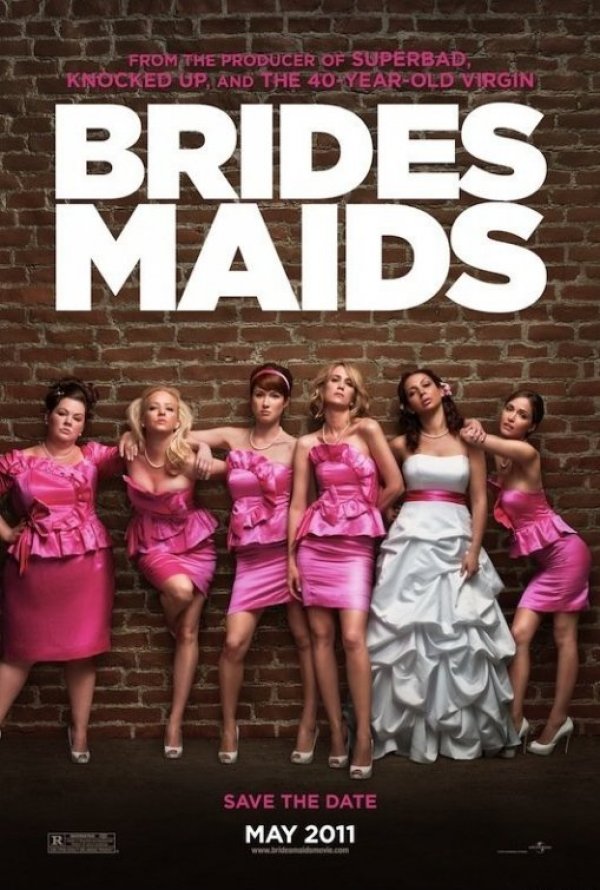
I love this movie poster. It's currently posted in every single subway station I frequent, and I find it just plain delightful. They look like a girl bridesmaid gang pulling off a bank heist or something. (I'm pretty sure this doesn't actually happen in the movie, FYI.) Other women in the train station seem just as intrigued by it, and we all seem to spend lots of commuting time studying it with fascination.

But there's one thing about the poster that's off to me. Why, why, WHY does the plus-size actress always have to wear sleeves? Even at the risk of ruining the perfect group ensemble thing they've got going on? It just screams LOOK THIS ACTRESS ISN'T AS THIN AS THE OTHERS OMG.

For the larger actress (Melissa McCarthy), it even looks like they sewed a different skirt and sleeves to the same dress bodice the other women are wearing, and the fabric is more matte. But why? Melissa McCarthy (aka Sookie from The Gilmore Girls) is a good-looking woman and I doubt anyone's retinas would be permanently seared from seeing her bare arms.

Glee pulls this stunt quite a bit too, having Ashley Fink wear long-sleeved versions of the Glee club's costumes. Once they even had her wear a black cardigan over the ombre Betsey Johnson dresses they wore while the rest of the girls went bare-armed, including Amber Riley, who is plus-sized but thinner than Ashley. It's almost as though this whole phenomenon requires that only one woman be isolated as too big to wear sleeveless dresses.

Now, I get that there are a lot of reasons this could be happening.

First, I know some plus size women (and frankly, even non-plus size women) are uncomfortable showing their arms. But if this is so, isn't that probably because we've created the very media environment that makes them uncomfortable? Furthermore, I would really question whether this is about the actresses' comfort and not about catering to a fat-phobic viewership. I've read the terrible comments people have posted on articles about Ashely Fink. Also, who can forget the whole Marie Claire debacle in which blogger Maura Kelly took issue with the Melissa McCarthy's sitcom Mike and Molly, saying  she didn't want to "watch two characters with rolls and rolls of fat kissing each other." So, obviously, we're dealing with a culture that tells overweight women that they don't deserve to be seen, that their bodies should be hidden for fear of offending people.

Next possible reason for all the arm-covering: As seamstresses--heck, as women--we know how wonky ready-to-wear sizes are. Even sewing patterns usually don't extend beyond a size 20, the equivalent of a 14 in retail sizes. So yes, perhaps it is difficult to find a wide range of sizes in the same dress, especially if a costume designer is sourcing from designer shops. And yet I'm still not buying it.

Ashley Fink wore a Betsey Johnson dress in the sectionals episode, so we know she can fit into them.

And for the last regionals competition (pictured above), the costume designer said in an interview that the dresses are bridesmaids dresses.
This year, the show needed a designer who’s used to making dresses of varying sizes on a tight turnaround, so who better than a bridal designer? Eyrich’s team ordered aqua bridesmaids dresses from Los Angeles-based Jenny Yoo (who also did the girls’ dresses for Kurt and Finn’s parents’ wedding) on a Wednesday; Yoo made them on a Thursday, and on Friday, Eyrich and her team fit the dresses on the girls — who require a wide range of sizes — and added sashes around the waists and applied jewels from deconstructed BCBG necklaces to the fronts. [emphasis mine]
My favorite comment on that article goes to Pamela, who said, "Could you clarify whether the cast require a variety/wide range of sizes? I’m not quite sure you’ve quite made your point about how there are fat people on this show." Nicely played, Pamela, nicely played.

Since the dresses were custom made, they easily could have been coordinated so they're all in the same style, sleeveless or not. Which brings us full-circle back to Bridesmaids. If the Glee costume designer had to go to bridesmaid dresses to be able to get dresses in a variety of sizes, shouldn't a movie called BRIDESMAIDS (!!!) be able to do the same?

I think what bothers me most about it is that it seems deliberately exclusive: just look at the way Melissa McCarthy is set off from the group in that Bridesmaids poster. Both of these shows depend on a group dynamic, about the bond that exists between the characters, whether it's a bunch of misfit glee clubbers or a motley bridal party. It's about the humanity that connects them all. And this whole "one of these things isn't like the others" crap is really messing with that bond. So please, Hollywood: could we accept the possibility that you don't have to be tiny to wear a sleeveless dress and look awesome doing it?

Tuesday, January 4, 2011

Foundation Garments and Body Image, Revisited

I must have been a very good little blogger last year, because Santa sure brought me a lot of fabulous presents! One of my favorites is the book Underwear: Fashion in Detail from the V&A. It's amazing. Seriously, it's a goldmine of information and pretty pictures. I would recommend it for anyone interested in fashion history, and especially those of us fascinated by the development of foundation garments over time. 

There's a quote in the introduction that has provided me with food for thought for days. While discussing the way the ideal body shape has changed at whim throughout fashion history, author Eleri Lynn writes:
"It is only since the 1960s that women have been expected to embody the fashionable ideal by way of diet and exercise and without the aid of foundation garments."
The reason this idea struck me so much is that as feminists, it's very easy to equate restrictive foundation garments with gender oppression—to the point that many now think of girdles as anti-feminist. In fact, every time I've written about my fascination with retro lingerie—particularly of the New Look variety—at least one commenter has asked me how I reconcile this enthusiasm with my feminist ideals. So the quote above is rather compelling in that it's probably the first time I've seen the decline of foundation garments interpreted as having an adverse effect on women.

Historically, it's easy to see how there's some sense in this. We currently worship the ideal of the perfect body obtained through diet and exercise, yet we still seem to be coming up short. Indeed, the decades since the 1960s (when traditional foundation garments fell out of favor) have been particularly bleak in terms of our relationship with food and exercise, seeing a massive rise in cases of eating disorders and poor body image in general. Is it possible that there's a direct connection between this crisis and the fact that women have traded their girdles for the gym?

I'm sure it's not quite that simple. But I do think there's something to be said for the idea that fashion is really about a quickly-changing silhouette; it seems we swing back and forth between ideals like Kate Moss or Christina Hendricks fast enough to give one whiplash. If you rely on an article of clothing to help you achieve this silhouette, you're probably bound to be happier than if you're futilely trying to change your very body shape through punishing crash diets and exercise routines (not to mention plastic surgery), right? Plus there seems to be a moral judgment on the use of body shapers now; there's a somewhat commonly held belief that Spanx are for people who haven't been hitting the gym hard enough.

But on the downside, any restrictive garment is just that: restrictive. And not being required to wear these garments on a daily basis has, arguably, improved our the quality of our lives in many other ways.

What do you think? We've certainly gone 'round and 'round on this topic before, but I so love the way the quote above frames the issue that I just had to write about it again. Whatever your opinion, it's certainly an interesting discussion for this time of year, with the deluge of "New Year, New You" get-thin-quick offers! (I'm so sick of those already, aren't you?)

Wednesday, August 18, 2010

We Live in the Good Body

So, I've been doing yoga two or three times a week lately. One of the teachers I practice with is named Anna and has a lovely Swedish accent. One of the things she often says during class is, "We have a good body" or "Your body is a good body." I've come to appreciate these little things she repeats, but I didn't understand the origin of them until my last class. During the final savasana (which is when we all lie on the floor rather blissed out at the end of class), Anna said she wanted to share a quote from Eve Ensler's The Good Body. It goes like this:

Maybe being good isn't about getting rid of anything.
Maybe being good has to do with living in the mess
in the frailty
in the failures
in the flaws.
Maybe what I tried to get rid of is the goodest part of me.
Think Passion.
Think Age. 
Think Round.
Maybe good is about developing the capacity to live fully inside everything.
Our body is our country,
the only city,
the only village,
the only every
we will ever know.

It goes on, but ends with this:

We live in a good body.
We live in the good body.
Good body. 
Good body.
Good body.

Maybe I was just really dehydrated, but damn. This quote said a lot to me. This may sound crazy, but hearing this quote is the first time that it hit me that my body is the only body I will ever have. (Sorry, do I sound high right now? I'm not, I swear.) But seriously, let that sink in for a moment. You will never have Christina Hendricks's body, or Dita Von Teese's, or Kate Moss's. The one you've got is the only one you'll ever know.

I don't know about you, but there's something about this realization that's oddly freeing. It's saying, "This is what I've got. Deal with it, World." I think so much of our culture is built around the idea of somehow getting another body, as strange as that may sound. ("Get a bikini body!") I've certainly spent plenty of time buying into the idea that I could somehow have a "better body" if I just did something differently. There's no upgrading to a better body in this lifetime. I already have a body, and it's a good body.

It's interesting to think about in terms of sewing and fashion. (And I'm not just saying that so I can build a post around this, honestly.) Just like yoga shouldn't be about getting one of these mythical bikini bodies, fashion shouldn't be about wanting to get rid of yourself. ("Maybe being good isn't about getting rid of anything.") Perhaps it's about honoring yourself, as you are, while also "developing the capacity to live fully inside everything." Maybe it's accepting that 31" waist while also wanting to become fully-realized: to become a skilled seamstress, yes, but to decorate yourself in a way that speaks to the innermost part of you and makes that part feel beautiful. Not to decorate yourself in a way that says "I'm working on getting rid of this belly/these thighs, etc."

So that's the thought for the day, folks. I hope it speaks to you as well. I better go before I start leading us in Ani Difranco songs or chanting or something.

Thursday, March 18, 2010

Underwear: What's Feminism Got to Do With It?

Yep, that's right. We're talking about underwear today.

Feminists are often (oh-so-condescendingly) called bra-burners as a result of a certain women's lib event in 1968, but did you know that this famed bra-burning never actually happened? In reality, protesters at the Miss America pagaent theatrically dumped symbolic items of women's oppression into a bin they called the "Freedom Trash Can." (Which actually shows quite a sense of humor, don't you think?) There was at least one bra among the items, as well as girdles, high heels, and pornographic magazines. But not a single thing was lit aflame - nor was it ever intended to be.

According to the women who were there, the fact that what lives on from this day is an insulting, nonfactual term for a very real movement is the most maddening thing of all. This article posits that the legend of bra-burning is a media-driven myth, and a mocking one at that. Bras were actually never meant to be a universal symbol of the women's movement (thank goodness).

Today's topic is a result of the comments on my last retro lingerie post, in which a few insightful readers asked how I consider myself a feminist and still wear constricting foundation garments. Excellent question!

I bring up the mythical bra-burning, because like the feminists who were there and saw what really happened, I get a little weary of certain items somehow becoming universal symbols of women's oppression. A girdle is a girdle, and yes, you can imbue it with characteristics of subjugation, or you can choose to just think of it as a piece of material with a certain sartorial purpose. However, the real answer is probably somewhere in the middle ground between those two extremes.

But the sticking point for me is trying to think of an undergarment as either feminist or not. What is feminism, after all? The movement for women's equality. And yes, an uncomfortable girdle can certainly keep one from feeling liberated (believe me, I've been there). But a girdle cannot work for women's freedom or detract from it on its own. Here in the U.S., a group in Utah was recently trying to pass legislation that would make miscarriage a punishable crime on par with homicide. Now THAT is anti-feminist.

I think the mythical bra-burning has sunk into our collective conscience more than we can really know. Hence the reason things like Spanx become major points of conversation in the feminist arena. But isn't this all a sort of sideshow that distracts from the major issues?

In terms of body image issues, I think the question is a trickier one and its connection to feminism is tenuous. But it boils down to this: Can women truly love and accept our bodies if we're trying to Spanx them into an oppressive ideal? I think it depends on the person and the motive. If you're a size 10 and you desperately want to believe that you're a size 8 so you squeeze into a too-tight foundation garment to look like you think you should look, then yeah. You're probably not feeling the body-acceptance love. But if you have a dress that could benefit from a smoothing or shaping garment and you don't have crazy expectations of what it's going to do for you and your self-image, I think that seems like a healthier approach. What doesn't seem healthy is feeling like a bad feminist if you want to experiment with different foundation garments.

As for how this all relates to sewing? Well, in the making of my last two pencil skirts, I've found that the fit is so good that there's no reason I would need a bodyshaper. Yet another point for sewing as a body-positive activity!

What do you all think? I know you'll have some opinions on this one!


Tuesday, March 16, 2010

Should Pattern Companies Update Their Sizing?

Question of the day! Do you think pattern sizing is outdated? We all know that the major pattern companies use a system that's quite old - meaning that it hasn't been affected by vanity sizing or the whims of the garment industry. But that also means that it's stuck in a static, decades-old status quo. Are there changes you think should be put into effect?

I've been thinking about this recently based on my own decision to get brutally honest about my size. I'm thrilled with the way things are fitting lately, but I'm surprised to find out that I'm borderline "plus" or "women's" size. For my BurdaStyle Jenny skirts, I have to cut a 44 in the hips. This is the last size before plus sizes start. I recently made a Simplicity blouse in a size 16. According to the info on the pattern envelope, the next size up is 18W, meaning women's - as opposed to misses' - sizes.

I hope I don't sound like I'm in denial here. If I'm practically plus-size, so be it. But there certainly seems to be a large disconnect somewhere, considering that I wear about a 10 in RTW, which is squarely a misses size.

This definitely points to the lack of patterns for larger women. BurdaStyle only releases some of their patterns in plus sizes. And I know that plus-size women often feel abandoned by the Big 4 pattern companies when it comes to cute patterns in larger sizes.

However, there does seem to be a shift happening in independent pattern companies. Colette Patterns and HotPatterns sizing runs closer to ready-to-wear. For what it's worth, I've now seen smaller seamstresses complaining that the smallest size in Colette Patterns is too big for them. Is it possible that there really is no way to please everyone?

[Colette Patterns Size Chart]

This isn't an argument about whether there's an obesity crisis in our country or not or a place to point out that women's bra sizes have gotten incrementally bigger over the years or whatever. It's just asking the question: what can pattern companies do to better serve their customers? What do you think, lovely readers?

Friday, March 12, 2010

Vintage Sewing and Body Image


So we've talked a lot here about sewing and body image in general, but it's occurred to me lately that the sewing of vintage patterns brings with it a distinct set of issues. I spent last night painstakingly fitting my muslin for the background dress, and it's interesting that even though the basics of sewing and fitting haven't changed, fitting modern bodies into the silhouettes of eras past can be rather disheartening.

First of all, there's the fact that vintage patterns are available in limited (usually smaller) sizes. There's nothing like shopping for vintage patterns and being confronted with bust measurements that are several inches smaller than my waist. Patterns with a 36" bust are often marked as extra large or the seller will make a fuss about how unusual it is to find a pattern in a particular size. (Speaking of which, have you guys seen this shop Booty Vintage? She specializes in larger patterns.) Patterns for plus size women were often matronly (remember Mrs. Exeter?). Shopping for vintage patterns can make you start to feel gigantic and alienated, no doubt.

I also find that fitting changes needed for vintage patterns can be far more intense and dramatic than contemporary patterns. (Makes sense, right?) I sometimes sew from a 34" bust vintage pattern. This will usually fit me in the shoulders, but beyond that, many inches need to be added all over. With every inch I add, I can choose to beat myself up or not let the measurements determine my self worth. I know what I'd like to choose every time, but emotions can take over. It's easy to start to feel like your body is abnormal if you don't match the 34-28-37 figure prescribed by your pattern envelope.

The other interesting thing about sewing with vintage patterns is that it can be very obvious - and disconcerting - how much fit has changed over the decades. In fact, the fit of vintage patterns can feel downright alien at first. Bodices were often long and blousier than we're used to. Waist seams were sometimes severely nipped in, creating an uncomfortable digging-into-the-midsection feeling if you're not wearing a girdle or waistcincher. The fit can be so different from decade to decade that it can feel like a complete crap shoot when you open a vintage pattern: what the heck is this thing going to look like? But perhaps that's part of the fun of it, too.

And then there are the illustrations on vintage patterns. Pattern illustrations of the past were idealistic at best (like the fabulous one above; pattern available here). It's easy to fall in love with a wasp-waisted dress, only to discover that it doesn't live up to your expectations once you put it on your body. So often the blame can be laid on our own bodies, rather than our optimistic expectations from looking at an exaggerated illustration on a pattern envelope.

For me, sometimes fitting something beyond recognition can be helpful, body-image wise. The background dress has required so much fitting that I've lost track of whether I'm adding or subtracting inches from the original pattern as I go. This takes away the trap of placing a value on each alteration that I do. All I notice is that I start to look better with each tweak. What I've learned most from sewing my own clothes is that nothing is more flattering to my body than a perfect fit, and that's the most confidence boosting thing of all, don't you think?

Thoughts, anyone? Are there particular body-image issues that you've come across while sewing from vintage patterns? Or do you think the issues are generally the same no matter what decade your pattern is from?

Tuesday, March 9, 2010

Back in the Dressing Room (Sigh.)

Let's take a little detour into ready-to-wear, shall we? I've happily been avoiding store fitting rooms lately. As you can imagine, I have quite a sufficient wardrobe, aside from the fact that I'm always adding new handmade items to it. (Plus no clothes shopping frees up funds for fabric and sewing machine feet! Yay!) But then I saw the above Tracy Reese dress in the latest Anthropologie catalog, and I was immediately drawn to it. I've never owned anything like it, really. The bodice shape, color, texture, and overall length are very different from anything I own. I was suddenly struck with the idea to make a dress like this someday. But how to know if this sort of thing would even suit me? Well, I supposed I could walk the block and a half to my local Anthro and try it on! And that's just what I did.

The first thing I did was to track down the dress. The second thing I did was to get honest about my size. (My recent remeasuring has certainly given me some new insights about my body.) I grabbed a 10.

So I took it to the dressing room (I actually picked up a few other items on my way - more on that soon). I pulled it over my head and it zipped up easily, but not too easily. I suppose that means it fit. But that's in the most generous sense of the word possible, because what I saw in the mirror does not describe "fit" to me. The draped top bodice hung sloppily. The bust did not flatter. The midsection was weirdly bumpy. And the length! Good god, are they really calling these things dresses?! (Yes, I know how old I sound right now.) Let's just say that bending over even slightly in this would be quite scandalous.

So obviously I wouldn't be tempted to spend $298 on this dress. I tried to focus solely on color and fabric. This creamy beige is not a color I would usually choose, but I thought it was a nice change, especially in a textured fabric like this. And the skirt/bodice fabric was divine - I believe it was an embroidered silk organza. So something in this vein might be in my future, but you have no idea how glad I am I can fit and sew it myself! (Actually, yes, you probably do.)

The other dress I tried on was the Traced Twirls dress. Isn't it adorable?

This fit in an 8 since the sides are shirred with elastic. And it is SO cute! The skirt has six gores, and I think it's actually fuller than a circle and the shape is super flattering. It has a cotton lining with a pink ruffle at the bottom that helps it stand out just perfectly. The bust has very cool petal-like folds. I love the 50s, Alfred Shaheen vibe of this. I will definitely be stealing some ideas from this number!

Next I tried on a couple pairs of pants. (DOUBLE SIGH.) Oh, pants. How I despise thee sometimes.

These are the Widest Leg Pants, and what I didn't realize when I picked them up is that they have a LARGE INVERTED PLEAT right smack on top of the thigh. In case you're wondering what this might look like (on me anyway), it is horrific. I think I'm going to have nightmares.

I also tried the Smooth Sailing pants, which won't give me nightmares, but they weren't anything to write home about either. They were a bit low-rise, making me appear quite wide in the middle. Taken in conjunction with the wide legs, there was a lot of wideness going on.

Anyway, the whole dressing room experience didn't do much for my self-esteem but it did make me awfully glad I can sew. Though, I must say, I'm mystified by pants fitting. I noticed recently that Sew Fast Sew Easy will be hosting a pant moulage class with Kenneth D. King. I'm tempted - anyone else?

Monday, February 15, 2010

News Flash: Models Are Thin (A Night at Thakoon)

So, as I mentioned yesterday, Jeff and I went to the Thakoon show at Fashion Week last night. This was the first event like this I've ever been to and my first impressions were: Wow, what a weird thing this is. The people, the ritual of it, the clothes, the models. We got there early and were lucky enough to get a little backstage tour. It was complete madness. I mean really: madness. People and things everywhere. It was kind of like a Bosch painting, except everyone was doing hair and pinning clothes rather than killing each other.

We had a standing room spot RIGHT at the end of the runway. Killer. The soundtrack started as a reverberating, thumping heartbeat (very "Tell-Tale Heart") and then morphed into a lovely, somber instrumental. The models started to walk down the runway. The clothes were gray, drab, and often furry. Their expressions were strained or bored. And their bodies?

Okay, I know I shouldn't have been surprised at their thinness. But believe me when I say that they looked a good 20 pounds thinner than they do in the photographs. Seeing it in person, only several feet away from me, was disturbing to a degree I couldn't really comprehend. Paired with the somber music, monastic ambiance, and drab clothing, it was truly like watching starved inmates march to their deaths. I was viscerally horrified as I witnessed spindly, fragile arms and legs, baggy pants seats, pinched faces, and protruding ribs.

It was admittedly hard for me to focus on the clothes. But of what I took in, it definitely wasn't my cup of tea. (And I don't think it will be Michelle Obama's cup of tea either, so I'll be surprised if we see her making use of this collection.) There was lots of fur, weird gray sweatpants, and fluffy hotpants made of what looked like twisted tulle. The few dresses I liked were definitely the most wearable, like this wonderful little number with pompom trim (a detail Style.com has already deemed as too "cutesy").

I also liked this LBD with ivory trim.

The one piece I could totally see Ms. Obama in? This printed, drapey number.

I'm not sure what had to die to make this coat, but it's scary.

Fluffy tulle hotpants!

I've been looking over the other recent shows at Style.com, and gray and serious seems to be the theme of the season. I have to say, I felt wildly unsophisticated in my tastes. I like pretty dresses in pretty colors. There was certainly none of that. As for what I wore? I went with the black and white polka dot dress, but never ended up taking off my coat. Good thing it's red and fabulous! I definitely stuck out like a sore thumb in this crowd. If you're interested in what the fashion types are wearing right now, it's this: Gray cape-like coats, tiny skirts, black leggings and sky-high black ankle boots. It painted a very militaristic, somber picture. And there I was in my huge fire-engine red coat, with a large, sparkly strawberry brooch pinned on the lapel. Oy.

So all in all? I'm glad I experienced this. But I'm surprised to feel so much more disturbed by the fashion industry today. As my post title suggests, none of this is exactly a news flash. But it was still unsettling. Oh, and celebrity sightings? Anna Wintour was there and I believe I caught the back of her shiny little bob as she was rushed out at the end of the show. But I did get a very good glimpse of Grace Coddington, the Vogue editor who stole the show in the documentary The September Issue.

All in all, I was happy to get back to Queens where people don't all dress alike and wear scary shoes. Also, after the show I had an intense comfort food craving so Jeff rushed me off to our favorite burger joint. Ah, back in the real world!

If you'd like to see the whole show, click here.

Friday, February 12, 2010

'Fessing Up: Taking Accurate Measurements

So, in the midst of all the body positivity going on here this week, I've been keeping a dirty little secret: all of the body measurements I've been sewing from are more aspirational than accurate. Yep, I'm one of those women who sucks in and pulls the measuring tape as tight as humanly possible. I also have a near-pathological fear of my waist measurement being over 30 inches, so I've conveniently recorded it as 29-1/2 inches for the last year or so. Ha! I generally wear my clothes rather fitted, so it hasn't been too disastrous up to this point. But lately I've noticed my garments feeling a little tight, so I decided it was time to face the facts. Last night I took a set of new, REAL measurements. No sucking, no pulling, no 29-1/2 inches.

So, things were definitely bigger than my fakey measurements. Surprise, surprise. They put me up a full size larger than I'm used to cutting out in contemporary patterns. But it's okay. It's OKAY. (That's my new mantra.)

Besides wanting to get honest with myself, the other reason I decided to get new measurements now is that I want to test and fit a basic pencil skirt pattern that will hopefully become a TNT ("tried 'n' true") pattern. So, in the scary moments of looking at the measurements, I just reminded myself that these numbers were going to help me make one hot pencil skirt that would feel a million times better than one that pulls across the hips and cuts into my waist.

So this weekend (with my new machine!) I'll be making a muslin of the BurdaStyle Jenny skirt with my own honest-to-god measurements. And I'm excited!

Now, time for you all to 'fess up. I know I'm not the only one guilty of sucking in and pulling when I take my measurements! Perhaps some new measurements are in order for you too?

P.S. One thing that struck me while writing the beginning of this post: I know some feminist blogs try to avoid mentioning any specific body measurements at all, as it can be triggering to those who have dealt with eating disorders. I've chosen to be somewhat frank about my waist measurement here because I think as sewists we can't be so afraid of the numbers that we won't even say them. Perhaps it would be liberating for me to publish the lot of my measurements for the whole damn internet to see! But if you disagree with my tactic, please speak up in the comments.

Thursday, February 11, 2010

Of Apples and Pears: the Body Type Question


Image from Built By Wendy Dresses

If you're a woman who hasn't grown up in a cave, you've probably been exposed to at least one magazine article about the major body types - and how to dress them - at some point in your life. These articles break women's bodies down into several supposedly distinct shapes: there's always the pear, the apple, and the hourglass, and then some random ones thrown in for good measure--i.e. rectangle, boyish, and so on. And, as sewists, you're probably also aware of Vogue Patterns' "key to figure flattery" (see image below) that supposedly helps you pick out sewing patterns by matching your body to a geometric shape (rectangle, triangle, etc.). I know these guides are supposed to help shed some light on our figures and fitting challenges, but I confess that they always leave me more confused than ever.

First of all, I never feel like any of the descriptions accurately describe my body. Pear? Yep, got the hips and butt, but not the narrow shoulders. (Yes, I know I wear a larger size on bottom than on top, but I honestly don't think I'm proportionately large on bottom. Feel free to tell me if I'm delusional here.) Hourglass? Close, if someone who wears a B cup can be considered an hourglass. All debating aside, though, isn't it kind of ridiculous and surreal to be trying to classify my body in such a weird, object-focused way? Or do I only feel this way because I don't identify strongly with any of the standard categories?

Vogue's Key to Figure Flattery

I just bought a copy of the new, well-reviewed sewing book Built By Wendy Dresses, and it does more of the same thing, identifying five body types. I was amused, however, to see a new category: "average." Ha! I was even more amused to identify so strongly with the description: "Hips and shoulders are aligned, bust size is neither small nor large, and the difference between hip and waist measurement is right around the standard of 10"."

Okay, mystery solved! I'm average. I think. Woo hoo. (Also amusing: one of the figure types above - athletic - is "also known as the carrot." The carrot! Now there's one I haven't heard.)

But more than just plain confusing me, I've actually started to get quite pissed off by all this classifying of body types and its supposed importance. Seriously, what would I possibly do with this revelation of my physical average-ness? I'm not going to start dressing any differently. And also, the Built by Wendy book compares body types to celebrity figures: J. Lo, Keira Knightly, Scarlett Johansson, and Angelina Jolie. Okay, but what about, say, Queen Latifah? See where I'm going with this?

The other thing that peeves me about the whole thing is the assumption that women need to compare their bodies to a fruit in order to understand how to dress. I mean, I've kind of gotten it figured out just from, you know, WEARING CLOTHES for the past 30 years.

What do you all think? Do you find all this apple, hourglass, and pear stuff helpful? Or irritating?

© Gertie's Blog For Better Sewing. Powered by Cake