Showing posts with label feminism. Show all posts

Friday, July 10, 2015

Sewing Scenes: Magic Mike XXL

Well, there's a title I didn't expect to be writing! Life has been a little heavy lately, and I decided that going to see Magic Mike XXL was the perfect remedy. I went with a group of six rowdy ladies, which is really the only way to see this show. It was spectacular.

I have a lot to say about this movie, starting with: sewing! There's a fabulous montage (God, I love a montage) where the ragtag bunch of "male entertainers" is getting ready for their big show, and it involves lots of DIY. There's a great little shot of a handheld sewing machine stitching along on a costume. These guys really do it all!

Of course, handheld sewing machines are notoriously terrible and there's no way an entire costume could be sewn on one in a pinch, but I'll suspend my disbelief.

(Side note: the first Magic Mike also included sewing, with the perfect Joe Maganiello as "Big Dick" Ritchie sewing a gold thong.)

If you have any desire at all to see this movie: run, don't walk! to your nearest theater. Not only is it a big, campy male stripper road trip odyssey filled with lots of eye candy, it's an unexpectedly feminist film. There's tons that could be said about the politics of female sexual desire, but what's more striking is the politics of female happiness.

These guys make it their mission to get their customers hot and bothered, for sure. But their primary goal in two instances is to get them to smile. There's a Joe Manganiello convenience store strip scene that will go down in history, the point of which is to get the dour cashier to grin. And he does! The crowd goes wild!


Which leads me to: male strippers are hilarious. They just are. They don't even have to try. I laughed my head off for two hours, as did my friends. Personally, I think that's the real secret to why women love this movie.


(Hey, I didn't say it was the only reason women love this movie.)

So, have you seen it? Will you? Please share your thoughts! The crafty feminist blogosphere needs to weigh in on this one.

Tuesday, May 5, 2015

Coming Soon! Gertie's New Fashion Sketchbook: Indispensable Figure Templates for Body-Positive Design


Readers! Between book projects, I've been working on a  . . . wait for it . . . book project! But this is a sketchbook project and one with a super exciting concept at that. Let me explain.

Have you ever bought one of those fashion sketchpads filled with croquis (body figure templates) all excited to hash out your ideas? And then once you realize the figures are a little bizarre-looking, your excitement fades a bit? (By "bizarre," I mean that the figures are strangely elongated and spindly, and twisted into strange poses like the "broken doll" or the "sad alien.") That's because fashion people work with a concept called "nine heads," where the figure is nine head-lengths tall. To put this in perspective, actual people are only seven to eight heads tall. Here's an interesting image that breaks it down:

Source

One of my missions over years has been to write about sewing and fashion in a body-positive, feminist way. So these nine-head ladies were bringing me down. And so the idea for this sketchbook was born and brilliant illustrator Sun Young Park brought it to life. Here's how it works:

For Gertie’s New Fashion Sketchbook, Gretchen Hirsch teamed up with illustrator Sun Young Park to reinvent traditional figure templates—known as croquis—for the 21st century. Instead of the unnaturally skinny, tall, and frequently off-balance croquis the fashion industry has been sketching on for decades, this game-changing alternative presents hundreds of realistically sized and proportioned female forms in balanced, lifelike poses. In addition, Park has rendered the croquis with multiple tracing lines, allowing the sketcher to follow the lines that most accurately reflect the body shape desired. Also included are an overview of the design and sketching process and a visual history of garment component styles, all to make it easier to create fashion sketches for women of all shapes and sizes.

The figures are presented in a "nested" configuration (almost like a sewing pattern!), so that you can follow the lines (bigger or smaller) to represent different figures. You can make the figures smaller on top or bottom to replicate a woman's actual curves and proportions. I tested the whole thing out with some wonderful sewing friends, and it really works! I can't wait to show you more once the actual books arrive.

But for now, just know that the sketchbook is available for pre-order!

Wednesday, March 19, 2014

Retro Makeup Giveaway Winner, Sewing Bee Casting, Gender and Sewing, Oh My!

And Winner Is . . . 

We had almost 400 entries to win Lauren Rennells's Retro Makeup! The prize goes to Jenni, who commented on March 14th at 3:56 am. (I hope you're in a really far away time zone, Jenni. Otherwise, you need to get more beauty sleep!) HRST Books will contact you to send the book. Thanks so much for the giveaway, Lauren and HRST!

Men!

Secondly, are you a man? Are you a man who sews as a hobby? Or do you know someone of that persuasion? The Sewing Bee is casting right now and they're specifically looking for more menfolk.

The catch is that you must be an amateur--i.e. not make the bulk of your income from sewing.

Sewing and Gender Diversity


I think there's an interesting blog post to be written here. I mean, the reason they're having trouble finding men is that there aren't that many men who sew as a hobby! And if they do, there's a good chance they might not want the whole world to know. Sewing is a traditionally female activity, and therefore hasn't been given a lot of respect in the past. While I'd rather see women making up the majority of the contestants (and I'm sure they will), I also want some diversity represented.

(Also, it's fun to watch the women kick the men's butts on The Great British Sewing Bee. I just started season 2, and the men are so out of their league!)

What do you think? Are you keen to have men well-represented on The Sewing Bee--more so than they make up the sewing population in general? Or do you think the show's contestants should represent the sewing population as it is?

Friday, November 1, 2013

Before and After: Thoughts on Makeup and Self-Image

The checkout line at my local grocery store always has a large selection of tabloids. Lately, a popular headline has been "Stars Without Makeup! You Won't Believe How Disgusting They Look!" or something like that. During the photoshoot for book #2 this week, I kept thinking about those tabloids.

I modeled on day two of the shoot, and thought it would be fun to capture the transition from mere mortal to model. I came into the studio with unstyled hair and no makeup (left picture) and an hour later I was all spackled and curled and ready to go!

On the subway to the shoot, I felt embarrassed by my lack of styling. On the way home that night, I felt embarrassed by all the makeup migrating to my under-eye region. You just can't win, right?

My everyday look is somewhere between these two extremes, which I guess is the case for most women. And I think we all have somewhat conflicting emotions about the whole thing. There's certainly no lack of pressure to conform to an ideal of beauty in our world. Think about all the time, money, and effort spent on products to achieve that ideal. It's exhausting! Do we like to read those tabloids about "stars without makeup" to make ourselves feel better? I think once you know how much work goes into a fully made-up look, you can let yourself off the hook a bit.

On the other hand, who doesn't like to play dress up? It's nice to have the option to go all out.

What do you think--do you feel bad about yourself sans makeup? Or do you regularly go au natural?

Friday, August 2, 2013

90s Fashion Is Now Vintage . . . And I'm Okay with That


The technical description of vintage is clothing from at least 20 years ago. Months ago, I had an argument with a student about whether his early 90s Calvin Klein coat was vintage. I was adamant that it wasn't . . . until I did the math. Yep, that's 20 years. Anything from 1993 or earlier is vintage, my friends.

Tuesday, June 11, 2013

That Fleshy Armpit Bit


A while back, I posted a magazine cover that showed a model from a side angle in a cap sleeve dress. Several people commented that the view of the model's fleshy underarm bit was unsightly. Now, while the angle of the photo wasn't my favorite for showing off a dress, it never would have occurred to me to be bothered by the model's underarm, of all things. I've spent long enough obsessing about various parts of my body, and it never even occurred to me that I was missing a vital part of myself to be disgusted by! So, to catch you all up: this is the part of the body where the arm meets the torso, and there's a little fold of flesh. Mon dieu!

Ever since then, I notice my fleshy underarm bits ALL THE TIME. There they are, just hanging out, being all unsightly.


I can't even get them to go away by distorting myself--no fair!

In all truthiness, I actually quite like those little flaps. I don't actually find them unsightly, unbecoming, or disgusting. I mean, what's the alternative? Maybe some sort of Barbie mutant arm that connects to the torso by plastic peg . . .

What does bother me, is that I'm now aware of the fleshy armpit bits. I scrutinize photos of myself, wondering if I'll be criticized like the model on the cover of that magazine. And I seriously resent having one more part of my body to worry about--like it wasn't enough to obsess over my tummy, triceps, biceps, hips, thigh circumference, inner thigh area, neck waddle, ankles, boobs, back fat, saddlebags, behind-knee area, hairy toes, upper lip, . . . . ok, you get the point.

So, here's my suggestion: can we all just agree, as women, that the fleshy armpit bit is of no concern? That it's normal, not repulsive? That it doesn't need to be covered in shame? Because, seriously, my brain is going to explode if I spend one more second worrying about it.

Or, alternatively, we could decide that it's just the sexiest part of the body ever and flaunt our armpit flaps brazenly all summer. What do you think?


Thursday, February 7, 2013

Style Shifts


I've been traveling a lot lately. (That's an understatement.) Recently, going through security at some airport, I saw a woman who looked like the epitome of cool to me. She was wearing a flannel shirt, skinny black jeans, and slouchy motorcycle boots. Granted, I have a serious devotion to Grunge; so it might have been my inner Riot Grrl responding to this ensemble. The 90s was an awesome decade, as far as I'm concerned. Hole, Doc Martens, slips as outerwear; I love it all.

Anyway, this airport sighting has left me with a motorcycle boot obsession. As I've written about before, being a vintage devotee can sometimes make you feel like you have an obligation to dress vintage at all times. But lately, I've been feeling the urge to dress, well . . . cooler. 

You're welcome, fellow Pony fangirls.
Perhaps dyeing my hair pink has set off some sort of latent adolescent rebellion. (And perhaps this is why people usually get their pink hair days out of the way in their 20s?) In any case, on some days lately I've been feeling slightly more Joan Jett than Joan Holloway.

One of the awesome things about being a modern woman is that we live in a time when it's not only acceptable but encouraged to indulge personal style whims, whether or not they fit with your usual "look." At the risk of sounding trite, may I quote India.Arie? "Sometimes I shave my legs and sometimes I don't/Sometimes I comb my hair and sometimes I won't/Depend on how the wind blows I might even paint my toes/It really just depends on what feels good in my soul."

While the idea of "personal style" can be watered down in a Lucky magazine sense (Are you a "bohemian eclectic"? A "nouveau prep"?, etc.), I believe there's no doubt that the feminist movement brought us freedom to experiment with fashion in a way that previous generations couldn't. (Of course, I'm not suggesting that this was the major coup of the Women's Rights movement, just a happy byproduct.) Do you agree?

Anyway, my new motorcyle boots are set to arrive tomorrow. (Stop the presses!) I will update you accordingly.

Thursday, December 20, 2012

Going Rogue

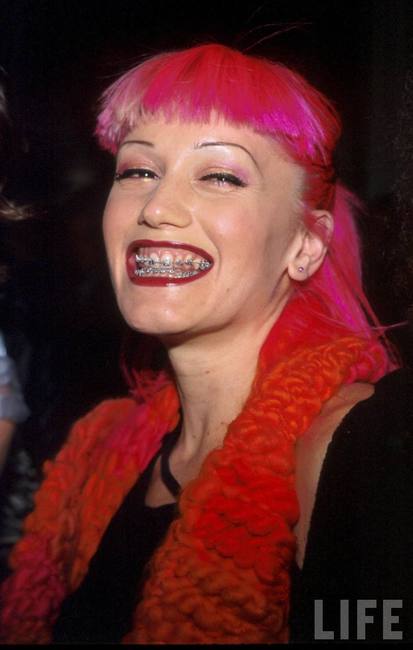
Gwen Stefani, late 90s
In my last post, I wrote about the maintenance and care of pink hair, but I realized I really want to talk more about the cultural implications of "alternative" beauty. (Another week, another crackpot feminist theory!)

I've been thinking lately about all the upkeep that is sold to us to be considered conventionally beautiful as a woman. Bikini waxes, gloss treatments, manicures, anti-aging treatments, etc. It's kind of exhausting just thinking about it, right? It's gotten me thinking that maybe the appeal of having an "unnatural" hair color is that you mentally put yourself outside of the rules of regular beauty. Maybe the message pink hair (or tattoos or piercings) sends is that you're not playing by the rules--so you can take your laser hair removal and shove it, okay? It's a liberating mindset.

You know those women's magazine articles that tell you the "top beauty don'ts" and stuff like that? As a younger woman, I remember reading on several occasions that it's an absolute crime to have a chipped manicure. I took it as gospel for a while, I suppose. But the day I realized that chipped nails aren't the end of the world, and can even look kind of cool (if you're into the whole grunge thing), it was kind of like a weight had been lifted.

The problem with this whole theory is that it's prone to backfire really, really quickly. Once you're considered an "alternative girl," you're sexualized in a whole new way. If you've ever had a dude on the street ask if you're a Suicide Girl, you know what I'm talking about. So while going rogue, beauty-wise, can be freeing--it definitely comes with its own set of issues. And it certainly doesn't make you oblivious or immune to regular beauty standards.

And even if you don't have pink hair or piercings, I think anyone reading this can relate in a way. Sewing your own clothes is the ultimate form of going rogue on the fashion and diet industries, I think. Making clothes to fit yourself (rather than making yourself fit clothes), is another way of going rogue. We can also stop being slaves to the trend-driven retail market and wear what we love--there are really no limits when you make it yourself.

Do you agree with all this? Do you see your sewing (or hair or whatever) as a form of rebellion against the status quo? Or is it naive to think that's even possible?

Friday, October 28, 2011

The Trends and Politics of Bra Shape


So, bra shapes have clearly changed significantly over the past 60 years. No argument there. In the famous "I dreamed . . ." Maidenform ad campaign, you see the bullet shape that the 50s were known for.

These seamed bras push your breasts into the point of the cup, making the plane of the chest above your bra appear flat. Modern women find this whole idea quite weird.

Fast forward to 2011. The "t-shirt bra"--a molded seamless bra resembling two basketballs cut in half--rules.

As lingerie giant Victoria's Secret describes the above bra: "Special padding lifts you up and out, instantly adding up to 2 full cup sizes for maximum cleavage and fullness." It seems the whole point of the t-shirt bra is create the illusion of perfectly round breasts, while forcing your actual breasts out of the cup so they're perched above your bra. Kind of weird too, right?

The interesting thing is that each era seems to think that they've created a "natural"  or "feminine" shape, when in fact both are quite manufactured. Just as body shapes go in and out of fashion, breast shape does too. And--it seems to me--the trend is influenced by the pornography of the day. Women of the 50s tried to emulate the pin-up girls that their men so adored. And we now live in the "Girls Next Door" era of grapefruit-shaped implants. Hence these crazy push-up bras with two-inch thick layers of molded foam.

I recently discovered the amazing Bali Flower bra (seamed but not overtly bullet-y), which has been in production for many years. It's listed on a lingerie site on a special "conical bras" page:


States the copy: "Whether it's nostalgia, the fashion runaways or the TV series Mad Men, those bullet-shaped bras are baaaaa-ck. We're by no means suggesting that this is the look of the modern woman, but why not enjoy a little dreamy escapism just for fun?"

It's interesting that this look is so on the fringes of "the look of the modern woman" that a site has to suggest that these are bras only worn for "escapism", like a Halloween costume or something. No, the modern woman wears what Oprah and porn has decreed we will wear: the t-shirt bra. Which is not costumey at all! No siree! It's just two lumps of foam strapped to your chest!

Anyway, I could probably write a book on this subject (we haven't even discussed the "no-bra" bra of the 60s!), but to boil this down to a blog post: bra shape is incredibly trend-driven, and tied up in all sorts of gender and sexual politics. And now, with the prevalence of plastic surgery, breast shape itself is changeable and trend-driven.

Do you agree? Do you see one shape as more "natural" than the other? Is one woman more "liberated" than the other?

Tuesday, January 4, 2011

Foundation Garments and Body Image, Revisited

I must have been a very good little blogger last year, because Santa sure brought me a lot of fabulous presents! One of my favorites is the book Underwear: Fashion in Detail from the V&A. It's amazing. Seriously, it's a goldmine of information and pretty pictures. I would recommend it for anyone interested in fashion history, and especially those of us fascinated by the development of foundation garments over time. 

There's a quote in the introduction that has provided me with food for thought for days. While discussing the way the ideal body shape has changed at whim throughout fashion history, author Eleri Lynn writes:
"It is only since the 1960s that women have been expected to embody the fashionable ideal by way of diet and exercise and without the aid of foundation garments."
The reason this idea struck me so much is that as feminists, it's very easy to equate restrictive foundation garments with gender oppression—to the point that many now think of girdles as anti-feminist. In fact, every time I've written about my fascination with retro lingerie—particularly of the New Look variety—at least one commenter has asked me how I reconcile this enthusiasm with my feminist ideals. So the quote above is rather compelling in that it's probably the first time I've seen the decline of foundation garments interpreted as having an adverse effect on women.

Historically, it's easy to see how there's some sense in this. We currently worship the ideal of the perfect body obtained through diet and exercise, yet we still seem to be coming up short. Indeed, the decades since the 1960s (when traditional foundation garments fell out of favor) have been particularly bleak in terms of our relationship with food and exercise, seeing a massive rise in cases of eating disorders and poor body image in general. Is it possible that there's a direct connection between this crisis and the fact that women have traded their girdles for the gym?

I'm sure it's not quite that simple. But I do think there's something to be said for the idea that fashion is really about a quickly-changing silhouette; it seems we swing back and forth between ideals like Kate Moss or Christina Hendricks fast enough to give one whiplash. If you rely on an article of clothing to help you achieve this silhouette, you're probably bound to be happier than if you're futilely trying to change your very body shape through punishing crash diets and exercise routines (not to mention plastic surgery), right? Plus there seems to be a moral judgment on the use of body shapers now; there's a somewhat commonly held belief that Spanx are for people who haven't been hitting the gym hard enough.

But on the downside, any restrictive garment is just that: restrictive. And not being required to wear these garments on a daily basis has, arguably, improved our the quality of our lives in many other ways.

What do you think? We've certainly gone 'round and 'round on this topic before, but I so love the way the quote above frames the issue that I just had to write about it again. Whatever your opinion, it's certainly an interesting discussion for this time of year, with the deluge of "New Year, New You" get-thin-quick offers! (I'm so sick of those already, aren't you?)

Wednesday, December 15, 2010

A Holiday Gift in Your Honor

Jeff and I were watching A Christmas Carol last night, and it really got me in the spirit of the season. I feel so fortunate this year and I've loved having all of you in my life. Luckily, I found the perfect way to give back: I've made a gift in honor of "the readers of GNBfBS" to Women for Women International, which provides business resources to women survivors of war. You can choose a symbolic gift, and of course I chose the sewing machine! (I especially love that the image provided is a vintage Singer Featherweight. A classic!)

According to Women for Women, "In Afghanistan, Kosovo and DR Congo, the path to economic self-sufficiency often begins with a small home tailoring business." It really struck me that a simple resource like a sewing machine could be a life-changing business asset. If you'd like to give a gift in honor of the seamstresses in your life, please visit the Women for Women website.

Happy Holidays, lovely readers. And, as always, happy sewing!

Wednesday, August 18, 2010

We Live in the Good Body

So, I've been doing yoga two or three times a week lately. One of the teachers I practice with is named Anna and has a lovely Swedish accent. One of the things she often says during class is, "We have a good body" or "Your body is a good body." I've come to appreciate these little things she repeats, but I didn't understand the origin of them until my last class. During the final savasana (which is when we all lie on the floor rather blissed out at the end of class), Anna said she wanted to share a quote from Eve Ensler's The Good Body. It goes like this:

Maybe being good isn't about getting rid of anything.
Maybe being good has to do with living in the mess
in the frailty
in the failures
in the flaws.
Maybe what I tried to get rid of is the goodest part of me.
Think Passion.
Think Age. 
Think Round.
Maybe good is about developing the capacity to live fully inside everything.
Our body is our country,
the only city,
the only village,
the only every
we will ever know.

It goes on, but ends with this:

We live in a good body.
We live in the good body.
Good body. 
Good body.
Good body.

Maybe I was just really dehydrated, but damn. This quote said a lot to me. This may sound crazy, but hearing this quote is the first time that it hit me that my body is the only body I will ever have. (Sorry, do I sound high right now? I'm not, I swear.) But seriously, let that sink in for a moment. You will never have Christina Hendricks's body, or Dita Von Teese's, or Kate Moss's. The one you've got is the only one you'll ever know.

I don't know about you, but there's something about this realization that's oddly freeing. It's saying, "This is what I've got. Deal with it, World." I think so much of our culture is built around the idea of somehow getting another body, as strange as that may sound. ("Get a bikini body!") I've certainly spent plenty of time buying into the idea that I could somehow have a "better body" if I just did something differently. There's no upgrading to a better body in this lifetime. I already have a body, and it's a good body.

It's interesting to think about in terms of sewing and fashion. (And I'm not just saying that so I can build a post around this, honestly.) Just like yoga shouldn't be about getting one of these mythical bikini bodies, fashion shouldn't be about wanting to get rid of yourself. ("Maybe being good isn't about getting rid of anything.") Perhaps it's about honoring yourself, as you are, while also "developing the capacity to live fully inside everything." Maybe it's accepting that 31" waist while also wanting to become fully-realized: to become a skilled seamstress, yes, but to decorate yourself in a way that speaks to the innermost part of you and makes that part feel beautiful. Not to decorate yourself in a way that says "I'm working on getting rid of this belly/these thighs, etc."

So that's the thought for the day, folks. I hope it speaks to you as well. I better go before I start leading us in Ani Difranco songs or chanting or something.

Wednesday, July 21, 2010

The Problem with Praising Modesty

 What the what?

Monday's post on what men think of vintage style garnered so many interesting comments! I was especially pleased to see the conversation take a turn toward sexism and expectations of modesty. I won't quote anyone in particular (so as not to put any one person on the spot), but some were disturbed by the idea of men treating women more respectfully if we're more covered up. Because, after all, what's the flip side of that? Men feeling they have permission to disrespect - or even outright assault - a woman if she's not dressed modestly. It's a common problem in many cultures to believe that a woman is "asking for it" if she's wearing something provocative, is it not?

Let me start by saying that I didn't mean to imply that I commend men on the street for being more respectful towards me if I'm dressed in a vintage style. I really don't think it's such a great thing for cat callers to be slightly more polite to me; I would prefer if men did not cat call to begin with. Also, though I suppose I tend to dress fairly modestly by some New York standards, it's not because I feel that to do so makes me more worthy of respect from men. It's just a personal style choice - and I don't believe it makes me morally superior in any way.

That out of the way, I've been wanting to write about the troublesome notion of modest fashion for some time now, but I admit I've shied away from it. The idea of modest dress is inextricably linked to religion and culture, and the last thing I want to do is offend anyone based on their beliefs in that area. Additionally, standards of modesty vary greatly from culture to culture - for some it means being covered from head to foot. For others, it's covering the upper arms and cleavage. It's impossible to dilute the idea of modest dress into a simple set of rules.

But it must be said that the expectation of female modesty in many cultures is an inherently sexist one. The idea is often that men must be saved from their own thoughts of temptation and it's a woman's responsibility to dress modestly to prevent men from having these thoughts. (There's an interesting survey on what modest dress means to young Christian men here if you want to take a look. I'll warn you that I couldn't look long as I found some of the basic ideas so disturbing.)

There's not much that enrages my cold femi-nazi heart like this idea of protecting men from temptation by dressing modestly. Why?
  • Standards of modesty for women put the onus on women themselves to prevent unwelcome advances and sexual assault. See, men just can't control themselves! If ever an idea were insulting to both genders, it's this one. Why don't we try everyone being responsible for their actions?
  • These double standards create hurtful divisions among women. For example, many feel it's okay to "slut-shame" a woman who shows more skin than she does. How often do we call each other sluts, skanks, whores, or worse?
  • At worst, it's a form of rape apology. The belief that women are sending sexual invitations by the way they dress is a prevalent one, sadly. 
Of course, many women choose to dress modestly out of their own accord and that's great. But the problem comes when we start placing a moral value on this choice - when we believe that covering up makes us more worthy of praise and respect. (Also, it's worth noting that etiquette calls for more modest dress at a memorial service than a barbecue and that this is a separate matter of social norms and manners.)

So, to bring this back to dressing vintage: yes, vintage styles can be more modest than current fashion. No, that doesn't give any of us the right to demean other women for choosing to show more skin. And, above all, we deserve respectful treatment from men no matter how we're dressed.

Monday, July 19, 2010

Do Men Find Vintage Sexy? (Do We Care?)

 Photo of a model wearing Dior's 1947 New Look by Richard Avedon (The menfolk are intrigued!)

I've been thinking a lot lately about how vintage style dressing is perceived - by ourselves and by the world around us. Two of my favorite outfits lately have been my pink swirly dress and my red suit, both coordinated with matching beige sandals and pocketbook. There's something about these ensembles that makes me carry myself slightly differently - in a sort of prim, ladylike way. (It must be the little purse!) And I've found myself being given the chivalrous treatment by men while in these outfits - doors are opened for me and elevator buttons are pressed.

Even the cat calls have gotten polite! (Cat calling is a hobby of many men in New York.) Where I'd gotten accustomed to a "Hey Sexy!" I'm now being called pretty. And the cat callers are noticing my outfits. While wearing the red suit: a man grinned at me in a predatory manner, and then said, unexpectedly, "That's a very pretty suit!" And while wearing the pink dress: "That's a pretty red dress - with a pretty lady in it!" (Everyone thinks my pink dress is red for some reason. Maybe it really is red and I'm the only one who hasn't noticed?).

In light of this, I've been thinking back to the chapter titled "Sex" in A Guide to Elegance. The author created lists of things that men find attractive or not, saying that she would once and for all separate "fact from fiction" on the matter. On the attractive list is "full skirts, tiny waists, and a long-legged look" and "collars on suits and jackets." On the unattractive side? "revealingly tight skirts and aggressively pointed bosoms" and "spike heels." (I find the idea of aggressively pointed bosoms very comical. Do they think our bosoms are going to come out and get them? Brings new meaning to the torpedo look!)

It's a bit of a twist to imagine men being turned off by tight skirts and spike heels. But I do think there's something classically appealing to men about the New Look era of dress even if they're socially programmed to like things short and tight. But truthfully, there does seem to be something girlishly feminine about a lovely shawl collared jacket that men find attractive, especially when paired with a full skirt. And the vintage look is often portrayed as whimsically sexy in movies (think Zooey Deschanel in 500 Days of Summer.)

But all this begs the fundamental question: do we care what men think about how we dress?

I do care what my husband thinks, mostly because Jeff has great instincts about clothes even though his own sartorial motto has always been "I'm no fashion plate." He'll tell me when my French darts look nipply and when my bow ties are too big. He'll even catch slight fitting issues that take a garment from problematic to perfect. But I can't say that I'm trying to send any covert sexual signals to him through my dress. In honesty, I think I would be disappointed if that were my mission. If I'm looking to "snare" him, the best way is usually through humor and intellect. And I think I'll keep it that way, thank you very much.

As for men on the street? Eh. It's kind of charming to see cat callers suddenly turn gentlemanly and appreciative of a shawl-collared suit, but I'd really rather not have any unsolicited comments on my looks from the peanut gallery.

And, of course, it must be said that all of this works purely on a heteronormative level. (Please excuse the academic jargon.) In other words, labeling what men find sexy is based on the assumption of a heterosexuality in which men are the pursuers and women are the prey, dressing only to claim the prized male gaze for themselves. It's certainly uncomfortable from a feminist perspective, which is why I think so many modern women are loathe to admit to dressing for men.

Now: as for the old adage of women dressing for women? Duh. Who else is actually going to know the difference between a shawl collar and a notched collar? Talking outfits with the girls is one of the great pleasures of being a woman, I think. Plus, it must be said, any compliments from women are generally not considered to have sexual or predatory undertones (because that would make women sexual aggressors and we can't have that!).

How about you? Do you think men find vintage style sexy? Do you care?

Monday, May 24, 2010

Retro and Race

Beyonce released a new video recently that set off a fascinating discussion about the relationship between race and retro fashion. In "Why Don't You Love Me?", the beautiful Ms. Knowles plays B.B. Homemaker, who is a sort of melange of two famed Betties: Betty Draper and Bettie Page. Let me state for the record before I get into the discussion: I loved this video. I think Beyonce does both Betty Draper and Bettie Page better than the originals! The scenes of her crying into her martini are truly priceless.

Wednesday, May 5, 2010

Introducing Gertie's Op-Ed Column: by Elizabethe!

I am super excited to be unveiling a new blog feature today - an opinion column written by YOU, my brilliant and beautiful readers. The idea for this new series came about the day of the fateful apron post, which you might recall set off a bit of a controversy in the comments. I was especially struck by the thoughtful words of regular commenter Elizabethe and knew I had to find a way to work her opinions into a post. And who better to write the post than the lady herself? Please read on for Elizabethe's op-ed piece!
* * * *
I want to thank Gertie for the chance to do the first reader Op-Ed. There are so many great comments on every one of Gertie’s posts that this is really an honor!

A while back, Gertie posted a series of patterns that seemed, to her, designed to “anchor” women to domesticity – remember the dress with the oven mitt actually attached? “Woman, don’t think of going so far from the stove that you wouldn’t need an oven mitt attached to you!” the pattern seemed to say to Gertie. I have to admit, I was a little taken aback by her response. I had a completely different feeling for the chic shirtdresses with matching aprons, and with dresses that feature so prominently the tools of domesticity. I thought, how cool! These are some patterns that take domesticity seriously, and think women should be dressed well no matter what they are doing.

The truth is, the various women’s movements have always had mixed feelings about what domesticity means for feminism. Does feminism mean women should be more like men and compete in a “man’s world” or should feminism mean traditional women’s work should be given a more valued place in society? I think the post-feminist movement of the late 20th century has answered a resounding “both.”

Indeed, women’s worlds never could be defined so neatly as “at work,” or “at home,” and some of these patterns Gertie posted reflect that on a practical level. A woman wearing a chic sheath dress with a matching apron does not think she’s going to “just be home” all day. A woman in a well-cut shirtdress could make her kids breakfast in the morning without worrying about getting grease stains on her dress, whip off her apron and go to a meeting with a local politician, serve on community board, or run a business from her home. Even if she “just” stays home, a woman wearing a nice outfit says to her kids and spouse, the people she interacts with on a daily basis, and herself that she thinks being at home is just as important as being at work.

Elizabethe is a wannabe home sewist and recently Ph.D'd historian. She works from home as a freelance copywriter when her two little boys decide to nap.

* * * *

Many thanks to Elizabethe for kicking off Gertie's Op-Ed Column! Want to contribute? I'd be delighted! I'm looking for readers to write op-ed posts on the discussion topics we cover here: feminism, body image, pop culture, and how this all relates to sewing and vintage style. The goal of this column is to provide diversity and balance to the views already expressed here. Take issue with something I've written? Want to bring up a debate of your own? Please e-mail me at gertie@blogforbettersewing.com to propose an op-ed post.
Wednesday, April 28, 2010

Sewing and Feminism 101

We've talked quite a bit around these parts about vintage sensibilities and feminism, but it occurred to me yesterday that we've never really gotten into the relationship between sewing itself and feminism. In other words, the basics. Women's feelings toward domestic arts have undergone such radical changes in the past sixty or so years, and it's interesting to examine how sewing fits into this puzzle. Now, mind you, I'm not a women's studies professor - I'm just someone with approximately a third of a PhD in theatre history, which I feel beholden to tell you is the same as no PhD at all. But here's how I understand it.

Let's start with the painfully obvious. Sewing is a domestic activity, and as such, has generally been in the domain of women's responsibilities. Prior to the advent of feminism, home sewing was wrapped up in all the other messy notions that prompted the need for women's liberation: the erasure of women into undervalued roles and social conditions that didn't allow for sustainable life choices choices outside of marriage and motherhood. (Just for the record: I am not bashing homemaking. I am merely glossing over several decades of women's history! I'm not sure which should offend you more.) With the publication of The Feminine Mystique and the evolution of first wave feminism, women began to detach themselves from domestic work and hence, home sewing became a less popular - perhaps even ridiculed - activity. We have the second wave of feminism to thank for many legal rights that women now have. But sadly, this era also saw the further decline of home crafts. For some, sewing might even have been considered an anti-feminist activity.

This idea has, thankfully, largely been criticized by third wave feminists, who, for the most part, rejected the idea that to gain power women must inject themselves into traditionally male activities and give up any aspirations of domestic bliss. As these feminists saw it, disowning any activity that was traditionally feminine further compounded the cultural notion that women's work is meaningless - that to do work of importance, we must take on traditionally male roles.

Feminism took a pronounced turn for the crafty with the publication of Stitch 'n Bitch, the book single-handedly responsible for making knitting cool again. Authored by Debbie Stoller, founder of the feminist magazine Bust, the book is both a how-to and a decidedly feminist call to action. The beautifully written chapter "Take Back the Knit" speaks volumes about the relationship between feminism and crafting. It's a gem of a chapter all around, but my favorite passage is this:
"Betty Friedan and other like-minded feminists had overlooked an important part of knitting when they viewed it simply as part of women's societal obligation to serve everyone around them--they had forgotten that knitting served the knitter as well."
In other words, crafts like sewing and knitting are nourishing to the soul, not just the home. Reflecting this idea, women today are far more likely to sew for themselves - because it feeds their creativity and sense of beauty - rather than a sense of gendered obligation. We live in a very exciting time in which feminism, punk DIY aesthetics, and eco-consciouness have converged to create a new crafting movement. And instead of feeling oppressed by sewing and other domestic arts, feminists now often use them as a means of connection to each other and to our creative selves.

But here's my question: why hasn't sewing become an emblem of crafty third-wave feminism in the way that knitting has? For whatever reason, sewing hasn't become a craft of choice for hip feminists, despite publishers' attempts to find the Stitch 'n Bitch of sewing. Sewing (or at least couture and vintage sewing) does seem to have less of a punk aesthetic than knitting - a bigger push towards refined methods rather than a scrappy DIY aesthetic. But I think we seamstresses need to start holding our own as crafty feminists!

What do you think? Do you see your sewing as feminist?

Tuesday, April 20, 2010

Now with Domestic Servitude Included!

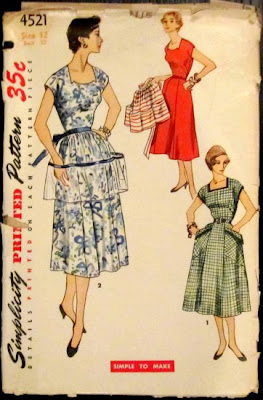
In this post, we looked at the history of the house dress, that humble uniform of domesticity which speaks volumes about gender and class. But even more fascinating, I think, are garments that included a household tool - like a potholder or an apron - attached to a main garment like a ball and chain. (Oh the tortured symbolism!) Simplicity 8413, pictured above, is a prime example. The dress and bolero are classy daywear, but at any point the detachable apron can be buttoned back on, ensuring that the little lady never strays too far from the kitchen!

Claire McCardell herself, the pioneer of American women's sportswear, seems to have perhaps initiated this idea. Take her early "popover dress" for instance:

Behold the attached oven mitt! The Met's information on this dress includes the following tidbit:
In utility achieved with ingenuity, McCardell found a synergy. The modern woman could both be chic and do the cooking. In a photograph by Louise Dahl-Wolfe, the model wearing the "Popover" has one hand in an oven mitt and the other in her capacious pocket.
Of course, this text fails to note that the oven mitt was ATTACHED to the dress - they make it sound like the photographer stuck it on the mannequin on a whim. No, the whole idea of the dress - style paired with domestic labor - was very premeditated.

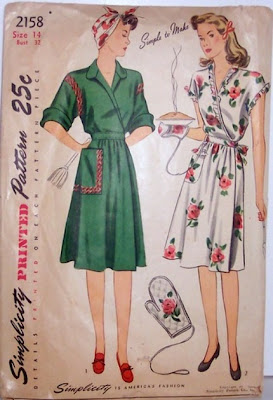
The idea was certainly reflected in patterns of the time, as on this 40s house dress with the oven mitt tethered on.


The concept also seems to have evolved into "hostess outfits:" dress ensembles that included aprons or smocks. Hostess aprons were often made of tulle or chiffon, and were meant to be seen by guests. These patterns, like the one below, went so far as to coordinate the whole domestic ensemble of dress and apron, both meant to be worn while entertaining - not as a house dress for chores only.

This maternity pattern with an interchangeable apron and stole really says it all, don't you think?

I think this was very much sold as the aspirational lifestyle for a woman of this time - switching effortlessly between gorgeous home and street wear, all while tending to her burgeoning brood. Though that chiffon apron will look mighty amusing during the third trimester, I think. Not that the pattern illustrations could actually show a pregnant woman. (Gasp! My delicate sensibilities!)

This pattern for little girls starts 'em young.

And perhaps the pattern most fraught with symbolism EVER: a wedding gown with an apron.

Chew on that for a second, will you? Though it's not of the decade we're focusing on here, I just couldn't resist.

So there you have it, readers. Aren't you glad our dresses have broken free of the shackles of the attached oven mitt?

Wednesday, April 7, 2010

The House Dress: a Humble History

When I think of house dresses, I usually think of cheap, matronly, brightly-printed sack dresses sold on the sidewalk outside the dollar stores in my neighborhood. But I've recently begun an inexplicable obsession with vintage house dress patterns that has completely turned around my thinking on the matter. Having now looked at every single entry in the this category of the vintage pattern wiki, I think it's safe to say that I've spent more time thinking about house dresses than I ever could have imagined.

First off, what is a house dress? Basically any relatively loose-fitting day dress with easy closures (usually in the front) that was worn to do household chores in. They seem to have started out as simple wrap shapes, like this one:
But you'll also see lots with zip-fronts (my personal fave), as well as more day-dress attributes: buttons, interesting collars, sashes, etc.

But aside from all the cool design features, I've found myself pondering the history and symbolism of the house dress, and I was fascinated to learn that an entire book has been published on the subject. The House Dress: a Story of Eroticism and Fashion looks at the evolution of this garment and goes on to suggest that Diane Von Furstenberg wrap dresses are direct descendants of the humble house dress. (In this interview with the author, that theory seems a little foggy, but it's still an interesting idea.) But this piece of copy is what really caught my eye:
The idea of the house dress is closely related to the concept of housework and domesticity. At the same time, it is distinguished by not being a uniform, thanks in particular to the decorations of the fabric.
In other words, there's a whole lot of gender, class, and race stuff all wrapped up into one seemingly innocuous garment. Women were relegated to domestic work, but there were varying statuses of this kind of work. To be a housekeeper in a hotel would be on the low end of the status spectrum, while being a housewife would carry great status. And yet the clothes were generally quite similar, as the author of the book above points out. See how closely the house dress silhouette resembles a waitress or maid uniform?

And the theory that fabric choice and decoration were the distinguishing factors in this complicated minefield of utilitarian garb is a fascinating one, especially when you look at the ubiquity of trims and appliques in these patterns. Ric rac was very prevalent on house dresses, as were lace and ruffles. But then other trims were more creative. Look at the heart pocket on this late 1930s pattern! I die.

Or perhaps you'd like your pattern with carrot embroidery transfers included?

A matching oven mitt? (Apparently you hook the oven mitt into your dress's belt, so it never leaves your side! Better go get that pie out of the oven!)

Another interesting class signifier is the variations in each pattern. House dress patterns were often sold in two lengths, with the floor length being called a "brunch coat" or "hostess gown." How glam! And doesn't it just scream "Sadie, Married Lady" rather than housemaid?

Over time, the house dress morphed into the more matronly silhouette that we now associate it with.

Silhouettes became more boxy, with gathers over the bust, creating a more tent-like shape.

But I'd prefer to remember the house dresses of earlier days, with their cute pockets and such.

In fact, I'm pretty dead set on making some house dresses for the summer. I think it could be an interesting experiment. How wearable are these dresses today? Do they still scream HOUSEWIFE! or MAID! depending on your fabric and trim choices?

What do you think, dear readers? Are you with me on the house dress love?
© Gertie's Blog For Better Sewing. Powered by Cake